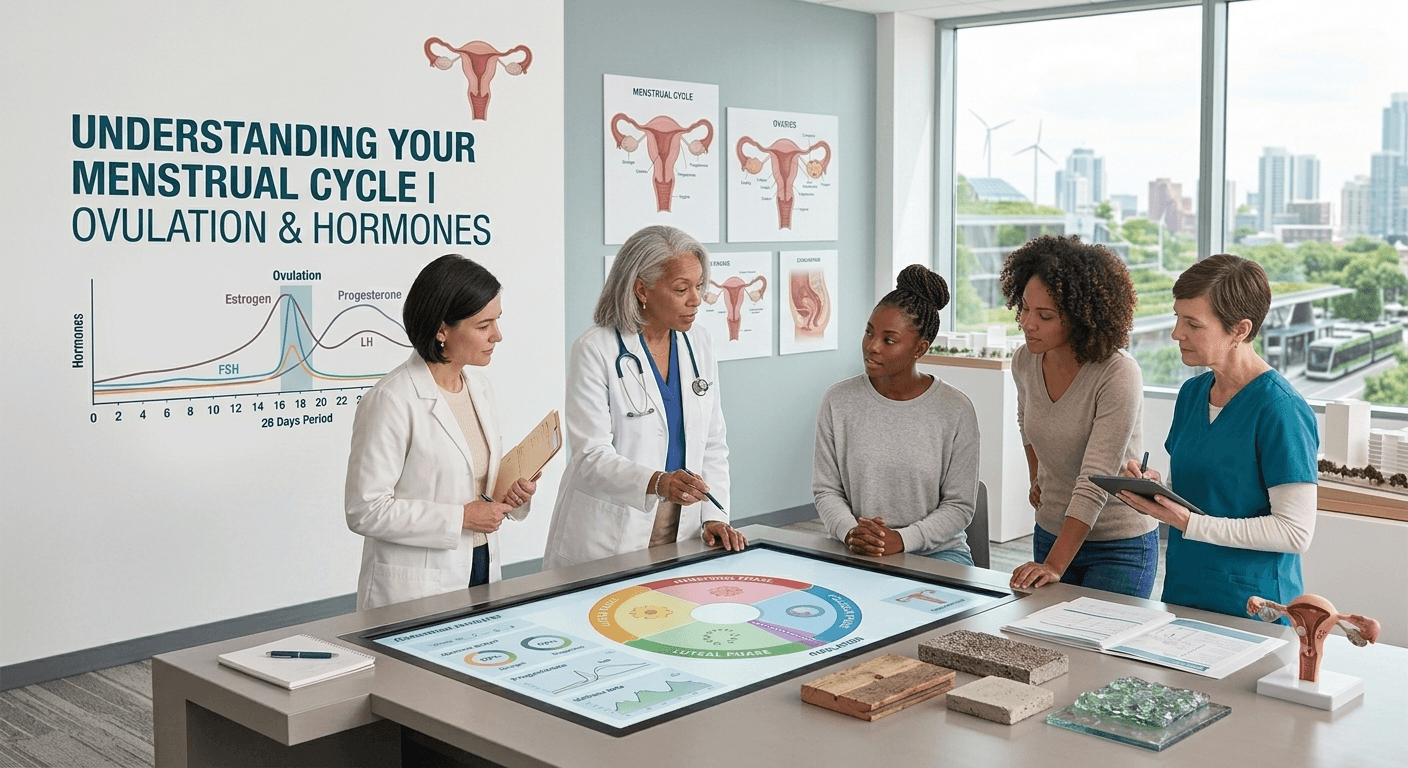
Your 3-Day Period Ovulation Guide: How We Pinpoint Your Fertile Days
If you notice your bleed only lasts three days, you might wonder what that means for your fertility. We often hear from women who worry that a shorter flow means they won’t release an egg properly or that their fertile window has shifted. Let us reassure you: a 3-day bleed is completely normal for millions of us across the country, and you can track your cycle just as accurately as anyone else.
Does a 3-Day Period Change When You Ovulate?
In short: no, it does not. We frequently assume that the length of our flow dictates when we ovulate, but your body actually follows a different timeline. What truly matters for you is your total cycle length—the number of days from your first day of full bleeding to the start of your next cycle.
Whether you bleed for three days or seven, your luteal phase (the time between your ovulation and your next period) usually stays fairly steady at roughly 12 to 14 days. This means that if you and your friend both have a typical 28-day cycle, you will both likely ovulate around Day 14, even if her period lasts all week and yours wraps up by Sunday afternoon.
Estimate Your Fertile Window
You can use these basic inputs to estimate when you are most fertile this month:
How Your Fertile Window Works
When you want to conceive—or when you want to avoid pregnancy—you need to know that your fertile window spans about six days. This window includes the five days leading up to your ovulation and the day you release an egg:
- Sperm can wait for you: Once sperm enter your reproductive tract, they can survive for up to five days in healthy cervical fluid.
- Your egg has a shorter window: Once you ovulate, your egg survives for only 12 to 24 hours unless fertilization occurs.
- Your prime timing: You are at your peak fertility during the two to three days right before you ovulate and the day of ovulation itself.
Tracking Clues Your Body Gives You
While an online tool gives you a great estimate, our bodies aren’t machines. You can pair your dates with these physical signs to know exactly when your fertile window opens:
1. Check Your Cervical Mucus
As you approach ovulation, your estrogen climbs. You will likely notice your discharge shifts from dry or sticky right after your period ends to a clear, slippery consistency that stretches like raw egg whites. When you see this, you know you are in your most fertile days.
2. Watch Your Basal Body Temperature (BBT)
If you take your temperature with a sensitive two-decimal thermometer the moment you wake up each morning, you will see a subtle shift. Your temperature typically drops slightly right before you ovulate and then spikes by about 0.5°F to 1°F once your body produces progesterone. This confirms that you have already ovulated.
3. Use Ovulation Predictor Kits (OPKs)
You can pick up standard urine test strips at your local pharmacy. They detect your luteinizing hormone (LH) surge, which usually appears 24 to 36 hours before you release an egg. If your period lasts only 3 days and your cycle is on the shorter side (like 24 to 26 days), you should start testing around Day 7 or 8 so you don’t miss your surge.
When Should You Talk to Your Doctor?
Having a light or 3-day bleed is usually just your natural baseline, especially if you have had it for years or if you recently stopped hormonal birth control. However, you should check in with your OB-GYN or primary care provider if:
- Your periods suddenly dropped from five or six days down to two or three without an obvious lifestyle change.
- Your overall cycle is erratic, arriving in fewer than 21 days or taking longer than 35 days.
- You experience severe pelvic pain, heavy mid-cycle spotting, or unexplained weight shifts.
- You have been actively trying to conceive for 12 months (or 6 months if you are 35 or older) without success.