Betadine Solution: Uses, Benefits, Safety, Side Effects, and Proper Application
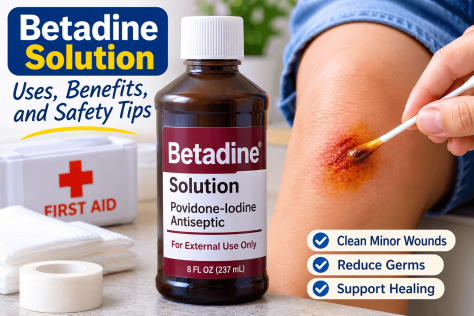
Betadine solution is a widely recognized antiseptic used to help clean minor wounds and reduce the number of microorganisms on the skin. It contains povidone-iodine, an ingredient known for its broad antimicrobial activity against many bacteria, fungi, viruses, and other microorganisms.
Many American households keep an antiseptic product in their first-aid supplies because minor cuts, scrapes, and skin injuries can happen during everyday activities. However, knowing when to use it, how to apply it, and when to avoid it is just as important as having it available.
This guide explains its common uses, how it works, potential benefits, possible reactions, precautions, and situations that require professional medical attention.
What Is Betadine Solution?
Betadine is a brand of antiseptic products that commonly contain povidone-iodine. This ingredient combines iodine with a carrier called povidone, allowing iodine to be released gradually when the product comes into contact with the skin.
It is designed to reduce microorganisms on the treated surface. Depending on the specific formulation, it may be used for minor wound cleansing, skin antisepsis, or preparation of the skin before certain medical procedures.
It is important to understand that not every product sold under this brand is intended for the same purpose. Some formulations are made for external skin use, while others are specially prepared for different medical applications.
Always check the product label before applying it.
How Does It Work?
Povidone-iodine works by releasing iodine, which interferes with important structures and processes inside microorganisms.
When applied appropriately, it can:
Damage microbial proteins.
Disrupt important cellular components.
Interfere with the activity of enzymes.
Reduce the number of microorganisms on the treated area.
Unlike an antibiotic that targets particular bacteria, this antiseptic has broad antimicrobial activity.
Its broad action makes it useful in several clinical and first-aid settings. Nevertheless, it does not replace proper wound cleaning, medical evaluation, or prescribed treatment when an injury is infected or serious.
Common Uses of Betadine Solution
The exact applications depend on the formulation and concentration. Common uses of povidone-iodine preparations include the following.
A. Cleaning Minor Cuts and Scrapes
Small cuts and superficial scrapes can occur while cooking, gardening, exercising, or performing household tasks.
An appropriate wound-care preparation may help reduce microorganisms on the affected surface. However, clean running water and gentle cleansing are generally important first steps.
For minor injuries:
Wash your hands before touching the wound.
Rinse the affected area with clean running water.
Gently remove visible dirt.
Follow the product label if an antiseptic is appropriate.
Cover the injury with a clean dressing when necessary.
Monitor the area for changes.
Do not assume that applying more antiseptic will make an injury heal faster.
B. Preparing Skin Before Medical Procedures
Healthcare professionals commonly use povidone-iodine preparations to reduce microorganisms on the skin before selected medical procedures.
This may include certain surgical preparations, injections, and other procedures where skin antisepsis is required.
The healthcare professional selects the appropriate preparation and allows it to be used according to the manufacturer’s instructions and clinical protocol.
C. Managing Minor Skin Injuries
Some formulations are intended for antiseptic use on minor skin injuries. Their suitability depends on the wound, the product concentration, and the instructions on its packaging.
Deep wounds, animal bites, puncture injuries, extensive burns, and heavily contaminated injuries require medical assessment rather than relying on a household antiseptic alone.
D. Reducing Skin Microorganisms
Povidone-iodine is also used in healthcare environments to lower the microbial burden on selected areas of the skin.
Its application may be part of a broader infection-prevention procedure. It should not be considered a substitute for handwashing, sterile technique, or other recommended precautions.
Potential Benefits
When used for an appropriate purpose, this antiseptic offers several useful properties.
Broad antimicrobial activity: It can act against different categories of microorganisms, making it useful in selected skin-preparation and first-aid situations.
Convenient application: The liquid formulation can be applied to appropriate skin surfaces using a clean applicator.
Established medical use: Povidone-iodine has been used in healthcare settings for skin antisepsis and infection-prevention procedures.
Availability: Certain formulations are available without a prescription in the United States, making them accessible for household first-aid supplies.
Versatile formulations: The ingredient is available in different products, including solutions, swabs, and other preparations designed for specific applications.
However, these benefits should not be confused with proof that it speeds up healing or treats every type of skin infection.
How to Use It Properly
Correct application depends on the formulation and intended use. Always read the Drug Facts label before using it.
For the standard U.S. 10% povidone-iodine first-aid solution, the product label provides the following directions:
Clean the affected area.
Apply a small amount to the appropriate area.
Follow the labeled frequency, which is generally one to three times daily.
Allow the product to dry before applying a sterile bandage.
Keep the treated area clean and monitor its condition.
Do not apply excessive amounts or use it more frequently than directed.
The standard consumer label also advises stopping and consulting a healthcare professional if the condition persists or becomes worse, or if use is needed for longer than one week.
Should You Apply It Directly to an Open Wound?
This is an important question because antiseptic products are not necessarily appropriate for every injury.
For uncomplicated minor cuts and scrapes, the American Academy of Dermatology recommends gently washing with mild soap and water, keeping the surface moist with petroleum jelly, and covering it with a clean bandage.
Mayo Clinic also advises against using iodine directly inside ordinary minor wounds because it may irritate injured tissue.
Therefore, do not assume that every cut needs an iodine-based product. Follow the instructions for the specific preparation and seek professional guidance when an injury is more than superficial.
Possible Side Effects
Most people tolerate appropriately used topical povidone-iodine products, but unwanted reactions can occur.
Possible effects include:
Skin Irritation
Some individuals may experience temporary irritation at the application site. This can include:
Mild burning or stinging.
Redness.
Itching.
Dryness.
Local discomfort.
Persistent irritation should not be ignored.
Allergic Reactions
Some people may develop sensitivity to povidone-iodine or another ingredient in the formulation.
Possible warning signs include:
Increasing redness.
A new rash.
Swelling.
Significant itching.
Blistering.
Stop using the product if a suspected allergic reaction develops.
Severe Skin Reactions
Rarely, more serious local skin reactions may occur, particularly with prolonged exposure.
If you develop extensive blistering, severe swelling, or rapidly worsening skin changes, seek medical attention.
Accidental Ingestion
This product is intended for external use. Swallowing it can be dangerous.
Keep the bottle away from children. If someone accidentally swallows it, contact Poison Control at 1-800-222-1222 in the United States or seek emergency medical assistance when appropriate.
Who Should Be Careful Before Using It?
Although it is available as an over-the-counter product, it is not suitable for everyone or every situation.
People With Previous Allergic Reactions
Anyone who has previously experienced an allergic reaction to povidone-iodine or another ingredient should avoid that preparation.
Read the complete ingredient list rather than relying only on the brand name.
People With Thyroid Conditions
Iodine can influence thyroid function, particularly when exposure is extensive, repeated, or prolonged.
People with thyroid disorders should discuss repeated or extensive use with their healthcare professional, especially when other iodine-containing products or treatments are involved.
Pregnant or Breastfeeding Women
Pregnancy and breastfeeding require additional consideration because iodine can be absorbed through the skin, particularly with extensive or repeated application.
Ask an obstetrician or other qualified healthcare professional before using it repeatedly or over large areas. Do not assume that a topical product is automatically risk-free during pregnancy.
People With Large Skin Injuries
Applying antiseptics over extensive areas can increase exposure and the possibility of unwanted reactions.
Large burns, widespread skin damage, and serious injuries should be assessed by a healthcare professional.
People Taking Certain Medications
Individuals receiving lithium treatment or other medications that may influence thyroid function should ask their clinician about repeated iodine exposure.
The safest approach is to review the complete medication list before using an iodine-based preparation regularly.
When Should You Avoid Using It?
The standard 10% consumer formulation carries specific warnings.
Do not use it:
Inside the eyes.
Over large areas of the body.
If you have an allergy to its ingredients.
For purposes not listed on the product packaging.
Ask a healthcare professional before using it on deep or puncture wounds, serious burns, or animal bites.
If symptoms continue or become worse, stop using it and seek medical advice.
Betadine Solution vs. Other Common Antiseptics
Several products are used in American households for cleaning and protecting injured skin. However, they do not all work in the same way.
Product | Main purpose | Important consideration |
|---|---|---|
Povidone-iodine | Antiseptic skin preparation | Follow formulation-specific directions |
Hydrogen peroxide | Oxidizing antiseptic | Can irritate damaged tissue |
Rubbing alcohol | Disinfection of certain surfaces and skin applications | Not appropriate for routine cleaning inside open wounds |
Chlorhexidine | Antiseptic skin preparation | Certain formulations must be kept away from the eyes and ears |
Petroleum jelly | Keeps minor wounds moist | Does not act as an antiseptic |
One important distinction is that petroleum jelly does not kill microorganisms. Its purpose in routine minor wound care is to maintain moisture and support healing.
Similarly, stronger antiseptic action does not automatically mean better wound healing. The right choice depends on the injury and the intended application.
Does It Help Prevent Wound Infections?
It can help reduce microorganisms on appropriately treated surfaces, which is why povidone-iodine is used in selected medical and first-aid applications.
However, no antiseptic guarantees that an infection will not develop.
Wound infections may occur when microorganisms enter damaged tissue, particularly if the injury is deep, contaminated, or not properly cleaned.
Pay attention to the following warning signs:
Increasing redness around the injury.
Worsening swelling.
Increasing tenderness or pain.
Pus or unusual drainage.
Skin that feels increasingly warm.
Red streaks extending away from the wound.
Fever or feeling generally unwell.
If these symptoms appear, contact a healthcare professional. Rapidly spreading redness, red streaks, fever with worsening symptoms, or severe pain may require urgent assessment.
How Long Does It Take for a Wound to Heal?
Healing time varies according to the depth, size, location, and condition of the injury.
A superficial scrape may improve within several days, while deeper injuries can take considerably longer.
Factors that may influence recovery include:
Age.
General health.
Blood circulation.
Diabetes.
Smoking.
Wound cleanliness.
Repeated friction or pressure.
Nutritional status.
An antiseptic does not automatically shorten this process. Proper cleansing, protection, and appropriate medical treatment remain important.
For a simple minor cut, the American Academy of Dermatology notes that many heal within a week or less.
Can You Use It on Burns?
The standard U.S. first-aid formulation is labeled to help prevent infection in minor burns.
However, not every burn should be treated at home.
For a small, superficial thermal burn, cool the affected area under cool running water. Avoid ice and do not apply an antiseptic before assessing the injury.
Seek medical attention for:
Deep burns.
Large burns.
Burns involving the face, hands, feet, or genitals.
Chemical or electrical burns.
Burns with extensive blistering.
Signs of infection.
Do not use a household antiseptic as a substitute for appropriate burn treatment.
Can Children Use It?
Parents should be particularly careful when choosing antiseptic products for children.
The appropriate product and application depend on the child’s age, the location of the injury, and the formulation.
For a small, uncomplicated scrape, gently washing with clean water and mild soap is often sufficient.
Before applying an antiseptic to a young child’s injured skin, check the product instructions and consult a pediatrician if you are unsure.
Never allow children to handle or drink the liquid. Keep it securely stored and out of reach.
How Should You Store It?
Proper storage helps maintain the quality of the product.
Consider these precautions:
Keep the bottle tightly closed when not in use.
Store it at room temperature according to the packaging.
Keep it away from excessive heat.
Avoid contamination of the bottle opening.
Do not use products that are expired or have damaged packaging.
Keep it away from children and pets.
For the standard consumer formulation, the manufacturer specifies storage around 77°F, with permitted temperature excursions between 59°F and 86°F.
Frequently Asked Questions
What is Betadine solution mainly used for?
It is an iodine-based antiseptic used in selected skin-preparation and first-aid situations. The standard 10% U.S. formulation is labeled to help prevent infection in minor cuts, scrapes, and burns.
Does it kill bacteria?
Yes. Povidone-iodine has antimicrobial activity against many types of bacteria. It also acts against certain fungi, viruses, and other microorganisms.
Can it be applied to an open cut?
The product label includes certain minor injuries, but routine wound-care recommendations differ. For uncomplicated cuts, gently washing with water and mild soap is generally preferred. Avoid putting iodine inside the wound unless a healthcare professional recommends an appropriate preparation.
Can it be used every day?
The standard first-aid product label allows one to three applications daily. However, it should not be used for longer than one week without medical advice.
Does it help wounds heal faster?
Its primary purpose is antisepsis, not directly accelerating tissue repair. Keeping a minor wound clean, moist, and protected is important for normal healing.
Can it be used on the face?
Use caution, particularly around the eyes, mouth, and other sensitive areas. The standard formulation must not be used in the eyes. Follow the product-specific instructions and obtain medical advice before applying it to sensitive facial skin.
Is it safe during pregnancy?
Pregnant women should consult a healthcare professional before repeated or extensive use. Iodine exposure may influence thyroid function, and the appropriate precautions depend on the amount and duration of exposure.
Can people with thyroid problems use it?
They should discuss its use with their healthcare professional, especially if repeated application is being considered. Iodine exposure can affect thyroid function in certain circumstances.
What happens if too much is applied?
Excessive or prolonged exposure may increase the risk of irritation and other unwanted reactions. Use only the amount and frequency stated on the packaging.
Can it be used for fungal infections?
Povidone-iodine has activity against certain fungi, but that does not mean every formulation is an appropriate treatment for fungal skin conditions. Persistent itching, scaling, or spreading rashes should be evaluated to identify the cause and select suitable treatment.
Does it leave stains?
Yes. Its characteristic brown color may temporarily stain the skin, clothing, or nearby surfaces. Follow the product instructions for cleaning accidental spills.
Can it be used on animal wounds?
Do not automatically use a human preparation on pets. Animals may lick treated areas, and the appropriate product depends on the injury and species. Ask a veterinarian before applying it.
Is it available without a prescription in the United States?
Certain topical first-aid formulations are available over the counter. Availability and intended use depend on the specific product.
What should I do if the wound becomes swollen or painful?
Increasing pain, redness, warmth, swelling, or drainage may indicate an infection. Contact a healthcare professional rather than repeatedly applying an antiseptic and waiting for improvement.
Can it replace antibiotics?
No. An antiseptic and an antibiotic are not interchangeable. Some infections require prescription medication, drainage, or other medical treatment.
Final Thoughts
Povidone-iodine is an established antiseptic ingredient with several applications in medical settings and first-aid products. Its ability to reduce microorganisms makes it useful for selected skin-preparation procedures and certain minor injuries.
Nevertheless, using an antiseptic correctly matters more than using it frequently. Not every cut, scrape, rash, or burn requires iodine. Simple wound cleansing and appropriate protection are often sufficient for minor injuries.
Before using any formulation, read its instructions, check the warnings, and consider your individual circumstances. If an injury is deep, worsening, infected, or unusually painful, professional medical assessment is the safer choice.
Medical disclaimer: This article is intended for educational purposes and does not replace individualized medical advice, diagnosis, or treatment. Always consult a qualified healthcare professional about persistent symptoms, serious injuries, or questions concerning medication safety.