We tend to think of a stroke as a clean fracture in time—one blinding moment, and the life you knew is gone. You are walking, speaking, running on instinct; then the scaffolding gives out, leaving you clawing to recover what used to take no effort at all. It is a terrifying premise.
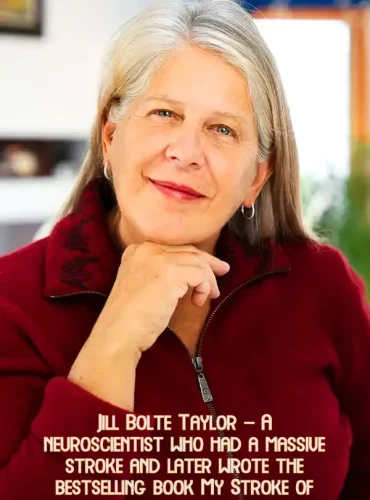
Yet for Jill Bolte Taylor, a Harvard neuroanatomist, that catastrophe opened an entirely different door. Hers wasn’t just a trauma to survive; it was a front-row seat to the dismantling of her own consciousness. To watch your own mind unravel—neurological piece by piece—and then spend years painstakingly piecing it back together is a journey few human beings have ever mapped from the inside. In My Stroke of Insight, Taylor gave us far more than a survivor’s memoir. She handed us a rare, incandescent study in human plasticity, proving that even when the brain fails us, our capacity to rebuild and transform remains vast. It leaves you with something far sharper than mere sympathy: an uneasy, electrifying sense of what the mind can endure.
Neuroscientist Who Spent Years Exploring Minds—Until Her Own Stopped Working
She had devoted years to studying how a brain functions. As a neuroanatomist, her work focused on its complex structure and how each hemisphere influences thought, emotion, and awareness. Curiosity led her to explore how both sides interact to shape identity, creativity, and perception in daily life. On a December morning in 1996, that lifelong focus moved from observation to firsthand experience—her own mind became the subject she had spent years examining.
At age thirty-seven, she opened her eyes to a piercing sensation throbbing behind her left eye. Unbeknownst to her, a storm had begun deep within her brain’s left hemisphere—an internal bleeding that would change her life forever. Her background in neuroscience granted her an extraordinary perspective as chaos unfolded within her own mind. While speech, logic, and movement started to fade, an inner observer remained alert, analyzing each diminishing function with startling precision, as if studying her own consciousness dissolving moment by moment.
Morning of a Stroke: Scientist Witnesses Her Own Mind Powering Down
What makes Jill Bolte Taylor’s story hit so hard isn’t just the medical drama—it’s the unnerving clarity of her witness. In My Stroke of Insight, she recounts the morning her mind betrayed her, marrying the analytical cool of a Harvard neuroanatomist with the raw vulnerability of someone watching the lights go out one by one. She feels a sudden, deafening rush behind her left eye, like a cascade of water carving through neural tissue. Then the architecture of everyday reality begins to dissolve. Colors don’t just register; they buzz with an electric charge. Familiar rhythms fracture into noise. Time pulls like taffy, softening around the edges until the clock stops making sense. Watching your own brain fail in real time sounds like a horror story, but in Taylor’s hands, it reads less like a descent into madness and more like an accidental awakening—a collision of terror, observation, and startling grace.
As bleeding progressed, activity in left hemisphere—responsible for logic, language, and structured thought—started to fade. Words slipped from reach, reading became impossible, and recognition of physical presence disappeared. Meanwhile, right hemisphere, linked to creativity, intuition, and broad awareness, grew more active. A wave of calm and connection washed over consciousness, bringing a profound sense of unity with all around.
Within her writing, she shared something unforgettable: “I felt like a genie liberated from its bottle. Energy of my spirit seemed to flow like a great whale gliding through a sea of silent euphoria.” Can you imagine feeling that free—untethered from limits you once believed defined you? What happens when identity dissolves and awareness expands beyond familiar boundaries? For her, that moment was not just poetic imagery; it was both scientific revelation and profound awakening. She experienced consciousness in a way that reshaped perception of existence itself. Was it simply a neurological event, or something far deeper? As layers of old identity fell away, clarity emerged, and with it came a heightened sense of connection and presence. Through that encounter, she didn’t just observe change—she became it. And if such transformation was possible for her, what unseen dimensions of awareness might still be waiting within you?
Long Road to Recovery: Rebuilding Life, One Neuron at a Time
That event brought intense physical and cognitive challenges, leaving her without the ability to walk, speak, or even remember how to use a phone. For someone who had devoted years to studying how minds function, it became both humbling and frightening. Yet she faced recovery with curiosity and determination that once fueled her scientific work.
For eight grinding years, she had to summon a level of patience most of us can barely fathom. Every motion took ruthless concentration. With every repetition, she was literally rewiring her brain through sheer, stubborn effort—and you have to wonder if you or I would have hung in there when the gains were practically invisible. For her, things we never think twice about—tying her shoes, brushing her teeth, gripping a fork—became monumental victories. Her speech didn’t just snap back, either; she clawed it back across endless hours, chanting nursery rhymes and drilling basic vocabulary with colorful flashcards. She lived in that daily grind between maddening frustration and hard-won breakthroughs, rebuilding herself inch by inch. When bone-deep exhaustion threatened to pull her under, her grit, discipline, and fierce resolve kept her going. Step by step, she turned suffering into rebirth and slowly, stubbornly took her life back.
What made this process remarkable was not only restoration of lost abilities but also mindset maintained through every stage. Recovery became an opportunity to intentionally reshape mental patterns, cultivating gratitude and compassion while releasing thoughts that no longer served.
In My Stroke of Insight, she revealed something that changes everything: “I realized that I had power to choose, moment by moment, who and how I wanted to be in world.” Think about that—what if every second truly held a choice? What if frustration could shift into patience simply because you decided it would? She discovered that mind isn’t locked into old patterns; it can rewire, reshape, and renew through focused intention and repeated action. Are thoughts permanent? Or are they habits waiting to be redirected? With steady awareness, she proved they can transform. Each breath offered a fresh decision—peace instead of fear, curiosity instead of despair, strength instead of confusion. And what happened when those tiny choices stacked up day after day? New neural pathways formed, clarity replaced chaos, and calm grew stronger than uncertainty. Her experience reminds us that transformation doesn’t require force or dramatic change; it begins with one conscious decision at a time. So what will you choose in your next moment?
My Stroke of Insight: A Message of Hope and Healing
When Jill Bolte Taylor walked onto that TED stage in 2006, I doubt anyone in the room knew they were about to witness history. Her talk didn’t just hand us information; it shook us to our core. You have to wonder why it hit everyone so hard. To me, it was the way she married hard science with raw, messy human vulnerability, pulling us directly into a reality most of us could never fathom.
She walked us through the stark divide between our brain’s two hemispheres—how her own perception fractured in real time, and how an uncanny peace bloomed even as her body gave out. Put yourself in her shoes: could you calmly study the unraveling of your own mind while it was happening to you? That fearless balance of intellect and openness is what grabbed us and refused to let go. We weren’t just sitting there listening to her; we were feeling every breath she took. In the end, she left us with a truth none of us can ignore: no matter how shattered our lives might feel, we still possess the grit to rebuild, adapt, and find a resilience we never realized we had.
That powerful moment eventually inspired a published work in 2008. It rose quickly to bestseller status, connecting with readers from many walks of life. For individuals in recovery along with those close to them, it offered reassurance and direction. For others, it served as a thoughtful exploration of awareness, spirituality, and what shapes a sense of self.
At core of her message rests a simple yet powerful idea: personal responsibility in shaping mental well-being. She describes how thought patterns along with daily choices can gradually reshape neural connections. Through steady mindfulness and nurturing uplifting emotion, new pathways can emerge—paths that encourage balance, joy, and lasting inner peace.

Her Legacy: Sparking a Worldwide Conversation About Brain Science
Today, Jill Bolte Taylor stands as a powerhouse in neuroscience and mental wellness—but what truly gives her voice such staying power? Is it simply her credentials, or the rare, hard-won experience that rebuilt her perspective from the inside out?
As she travels the globe, she challenges us to look inward and confront a fundamental question: what untapped potential is quietly waiting inside our own minds? She isn’t just reciting laboratory data; she is sharing hard truth earned through personal survival and radical transformation. Can a brain truly rebuild, adapt, and expand after catastrophic trauma? She is living proof that it can.
Her work urges us to take fierce ownership of our mental well-being, to trust the resilience we already carry, and to stop viewing the human brain as a rigid machine. In her hands, it becomes what it has always been: dynamic, remarkably elastic, and capable of breathtaking renewal.
This journey serves as a powerful reminder that even through life’s toughest moments, capacity for renewal continues to exist. What began as a deeply challenging chapter evolved into a rare perspective on existence—one that still inspires and uplifts people across many communities.
As described in her reflections, investing time in nurturing inner peace and joy allows those feelings to flow outward, shaping an environment marked by calm, clarity, and steady positivity.
Lessons from Her Journey: What We Can Learn from Her Experience
Her story offers valuable lessons for everyone, regardless of personal experiences. Here are a few key takeaways:
Brain’s Ability to Heal
Recovery from serious brain injury demonstrates remarkable resilience of a mind. Even after severe challenges, a brain can adapt, reorganize, and regain lost abilities. This ability to change and renew serves as a strong reminder that transformation is possible at any stage of life.
Power of Presence
A significant shift in awareness can reveal value of being fully present. By noticing thoughts and emotions without judgment, it becomes possible to respond to challenges with greater clarity, cultivating a lasting sense of inner calm.
Necessity of Self-Care
Healing is often a slow and intentional journey that requires patience and self-compassion. Prioritizing physical and mental well-being is essential, reminding us that nurturing ourselves allows for a fuller, healthier life.
A Shift in Perspective
Experiencing profound change can alter how life is viewed, emphasizing connection, gratitude, and compassion. Focusing on what remains rather than what is lost can lead to a deeper understanding of life’s meaning.
Strength of Connection
Recovery seldom occurs in isolation. A consistent network of family, friends, and skilled individuals can provide motivation to navigate difficult moments. Connecting with others and fostering meaningful bonds creates a foundation for growth and renewal, transforming overwhelming challenges into experiences that can be approached with strength and hope.
What type of brain event did she experience, and how does it differ from other types?
She experienced a hemorrhage inside her brain—a sudden rupture where a vessel burst and blood spilled into surrounding tissue. What does it mean when something so vital gives way without warning? This kind of crisis may occur less often than one caused by a blockage, yet isn’t it striking how it can bring far more severe and life-threatening consequences? Why does it happen at all? Often, intense pressure within arteries weakens fragile walls over time. Sometimes an aneurysm silently expands until it tears. In other cases, tangled connections between arteries and veins—known as arteriovenous malformations, or AVMs—create instability that eventually breaks. Each possibility carries weight, yet each also reveals how delicate and complex brain function truly is. When such an event unfolds, it doesn’t just interrupt physical processes—it can instantly alter perception, awareness, and identity. And if something so small can change so much, doesn’t that deepen appreciation for every steady heartbeat and clear thought experienced each day?
In Jill’s situation, an undiagnosed AVM—a tangled cluster of irregular vessels inside her brain—was responsible. Immediate medical action, often involving surgery, is usually required to halt bleeding and relieve intense pressure within delicate neural tissue.
How did her background as a neuroscientist influence her recovery?
Her background as a neuroanatomist offered a distinct advantage throughout recovery. With extensive knowledge of brain structure and function, she approached rehabilitation through a lens of curiosity and research. For instance:
She understood significance of neuroplasticity—capacity of a brain to rewire itself—and applied this knowledge to navigate recovery process.
She managed to observe and document her symptoms with a level of detail rarely captured by survivors, which later allowed her to articulate her experience with remarkable clarity in her published reflections.
Her scientific background gave her hope and purpose, since she understood her brain could recover and adapt with time.
Still, deep knowledge of neuroscience could not shield her from emotional and psychological challenges of recovery. She encountered moments of fear, frustration, and grief while striving to rediscover identity beyond former self.
What role did her family play in her recovery?
Her family became her bedrock through the long haul of recovery, meeting her vulnerability with steady, unwavering devotion. Who stays beside you when your words vanish and the simplest daily tasks become completely insurmountable? Her mother did.
Armed with a professional background in rehabilitation, her mother moved in to shoulder the exhausting mantle of primary caregiver. Day after grueling day, she guided her through the quiet labor of reclaiming an identity she had once taken for granted. How do you learn to walk again when your own balance feels alien? How do you speak when language itself slips beyond your grasp? Patiently, day in and day out, her mother sat with her—helping her shape raw sounds into words, reacquaint herself with ordinary objects, and take those first fragile steps forward.
Progress was measured in inches, not overnight breakthroughs, but her mother’s resolve never fractured. Jill has often called that quiet patience nothing short of life-saving. Could she have made the same miraculous journey without that steady hand at her back? It is hard to imagine.
Through relentless belief and quiet grace, her family turned a terrifying void into a sanctuary for healing. Their presence offered the deep emotional grounding she needed to pour every ounce of energy into reclaiming her mind. In the end, her story isn’t just a testament to neuroplasticity—it is a reminder of how vital a fierce, reliable circle of care is for anyone trying to claw their way back from profound trauma.
What are some practical tools or techniques she recommends for maintaining mental health and well-being?
In her writings and talks, she outlines practical approaches for nurturing emotional balance and inner peace—methods deeply influenced by her own recovery experience. These include:
Engaging in mindfulness: She emphasizes staying fully present within each moment and observing emotions or thoughts without attaching judgment. This practice encourages awareness of unhelpful mental patterns and allows more deliberate, grounded responses.
Focusing on gratitude: She encourages people to build appreciation, allowing thoughts to shift away from stress and negativity toward positivity and joy.
Engaging in physical activity: It boosts overall vitality while encouraging formation of new neural pathways, improving coordination, focus, and emotional balance over time.
Cultivating relationships: She highlights value of connecting with others and fostering meaningful bonds. Positive social interactions strengthen emotional resilience and overall vitality.
Directing inner focus: She stresses that individuals can channel mental energy toward chosen patterns. By consciously cultivating emotions like love, compassion, and joy, corresponding neural pathways strengthen, gradually reshaping mindset and emotional equilibrium.
Conclusion: An Insight for Us All
Her experience serves as a striking reflection of vulnerability and resilience within a human mind. Approaching a life-altering event with scientific curiosity, she confronted challenges with steadfast determination, turning hardship into inspiration. Through persistence and profound insight, her work broadened understanding of neural recovery, touching countless individuals and sparking optimism for those navigating personal journeys toward renewal.
Ultimately, this journey reaches far beyond one life-altering crisis—it reflects inner strength that rises through struggle, uncovers purpose amid difficulty, and guides a person toward greater wisdom. As she later expressed, she no longer felt identical to who she had been before that crisis, yet she viewed that shift as something meaningful. She spoke of gaining a deeper sense of identity and a renewed appreciation for what it means to live with awareness and intention.
By sharing this journey with others, a rare and profound perspective emerges—revealing how a mind can rebuild, adapt, and grow, while spirit continues to reach beyond limits once thought unreachable.