What Is the AC Joint?
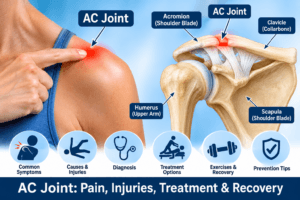
This small connection is located at the uppermost part of the shoulder, where the outer end of the collarbone meets a bony projection of the shoulder blade called the acromion. Together, these structures form an important part of the shoulder girdle.Unlike the main shoulder joint, which allows extensive movement of the upper arm, this connection primarily supports controlled gliding and rotation of the shoulder blade and collarbone. These subtle movements help the entire arm move smoothly.A capsule surrounds the area, while strong connective tissues help hold the bones in their normal positions. The surrounding muscles also contribute to stability by controlling shoulder movement.Where Is It Located?
You can find this structure by gently feeling the upper surface of your shoulder near the outer end of your collarbone. There is often a small bump where the two bones meet.It sits above the main ball-and-socket shoulder joint. This distinction is important because an injury in this location is not the same as a conventional shoulder dislocation.Which Structures Make Up This Area?
- Clavicle: This is the collarbone that connects the upper chest to the shoulder.
- Acromion: This is the bony extension of the scapula that forms the uppermost portion of the shoulder.
- Joint cartilage: This tissue helps reduce friction between the adjoining bone surfaces.
- Joint capsule: This surrounding tissue provides additional support and helps maintain the connection.
- Acromioclavicular ligaments: These connective tissues help stabilize the two bones against excessive movement.
- Coracoclavicular ligaments: The conoid and trapezoid ligaments provide important vertical stability.
What Does This Structure Do?
Its main purpose is to maintain the relationship between the collarbone and shoulder blade while allowing the shoulder girdle to move. Even though the movement occurring directly at this connection is relatively small, it contributes to larger movements of the arm.Some of its important functions include:- Supporting normal shoulder blade movement.
- Helping the arm move overhead.
- Maintaining alignment between the collarbone and shoulder blade.
- Transferring mechanical forces through the shoulder girdle.
- Contributing to stability during pushing, pulling, and lifting.
- Supporting coordinated movements during sports and everyday activities.
What Is an AC Joint Injury?
An injury in this region generally occurs when the ligaments supporting the connection become stretched, partially torn, or completely disrupted. Depending on the severity, the collarbone may remain in its normal position or become noticeably displaced.Many people refer to a more significant injury as a shoulder separation. This term describes damage to the supporting ligaments rather than displacement of the upper arm bone from its socket.The severity can range from a mild sprain to a major disruption involving multiple supporting structures. Appropriate treatment depends on the extent of damage, symptoms, physical demands, and individual recovery goals.Common Causes of AC Joint Problems
There are several ways this part of the shoulder can become irritated or injured. Some problems happen suddenly, while others develop gradually over months or years.1. Falling Directly on the Shoulder
A direct impact is one of the most common causes of traumatic damage. When someone falls onto the outer portion of the shoulder, the force can push the shoulder blade downward while the collarbone remains relatively fixed.This sudden movement places considerable stress on the supporting ligaments. The result may be swelling, tenderness, restricted movement, or visible changes in shoulder shape.2. Sports-Related Injuries
Contact sports create situations in which players may collide with other athletes or fall onto hard playing surfaces. Football, hockey, rugby, wrestling, and lacrosse are examples of activities associated with this type of injury.Cycling, skiing, snowboarding, and recreational sports can also involve falls that place pressure on the upper shoulder.3. Weightlifting and Repetitive Exercise
Repeated heavy lifting can place stress on the tissues around this connection. Certain exercises, particularly those involving heavy pressing or repeated movements across the body, may aggravate an already sensitive area.Bench presses, overhead presses, dips, and other demanding upper-body exercises may contribute to symptoms in susceptible individuals. However, these activities do not automatically cause damage when performed correctly.AC Joint Injury Assessment
Answer the questions to estimate injury severity based on the Rockwood classification scale.
Disclaimer: Educational only. Not a medical diagnosis. AC joint separation grades require clinical examination and shoulder X-rays.
4. Automobile Accidents
Motor vehicle collisions can produce sudden forces that affect several parts of the shoulder. A direct impact, rapid deceleration, or contact with the vehicle interior may injure the supporting ligaments.Following a significant accident, an evaluation is important because other injuries, including fractures, may occur at the same time.5. Age-Related Changes
As people get older, the cartilage and other tissues around their joints may gradually change. Years of normal movement, previous injuries, and repeated mechanical stress can contribute to degenerative conditions.These changes may eventually produce stiffness, tenderness, or discomfort during certain activities.Signs and Symptoms to Recognize
Symptoms depend on the underlying problem. A recent traumatic injury may produce immediate discomfort, whereas degenerative changes often develop gradually.Common warning signs include:- Pain at the top of the shoulder near the collarbone.
- Tenderness when touching the affected area.
- Swelling or bruising after an injury.
- Discomfort when lifting the arm overhead.
- Pain when reaching across the chest.
- Difficulty carrying heavy objects.
- Reduced shoulder strength because of pain.
- Stiffness following periods of inactivity.
- Difficulty sleeping on the affected side.
- A noticeable bump or change in shoulder contour after a separation injury.
Understanding the Different Types of AC Joint Injuries
Healthcare professionals commonly use the Rockwood classification system to describe the severity of traumatic separation injuries. It includes six categories based on ligament damage and the direction or degree of bone displacement.Type I: Mild Sprain
This is generally the least severe category. The supporting ligaments become stretched, but the main stabilizing structures remain largely intact.Individuals may experience localized tenderness and mild swelling. X-rays generally do not show significant displacement.Most people improve with conservative treatment, activity modification, and gradual rehabilitation.Type II: Partial Disruption
In this category, the acromioclavicular ligament is torn, while the coracoclavicular ligaments are sprained rather than completely disrupted.The collarbone may appear slightly elevated compared with its normal position. Pain and swelling can be more noticeable than in a mild sprain.Nonoperative treatment is commonly recommended, although recovery needs to be monitored.Type III: More Significant Separation
This injury involves disruption of both the acromioclavicular and coracoclavicular ligaments. The collarbone becomes more noticeably displaced, and the normal relationship between the bones is altered.Some individuals develop a visible bump at the top of the shoulder. Others experience pain, weakness, or difficulty returning to demanding physical activities.Treatment decisions are individualized. Many patients initially receive nonsurgical treatment, while selected individuals may benefit from an orthopedic consultation about surgical options.Type IV: Posterior Displacement
This less common injury involves displacement of the outer collarbone backward into or toward the trapezius muscle. The surrounding tissues can become significantly disturbed.Because of the degree and direction of displacement, surgical evaluation is generally necessary.Type V: Severe Displacement
This category involves extensive ligament disruption and considerable upward displacement of the collarbone. The surrounding soft tissues may also be damaged.Patients may experience substantial deformity and functional limitations. Surgical treatment is commonly considered.Type VI: Inferior Displacement
This is a rare and severe injury in which the outer end of the collarbone moves downward into an abnormal position beneath the acromion or coracoid region.It often occurs following high-energy trauma and requires prompt specialist assessment.AC Joint Pain: What Does It Feel Like?
Pain in this location is often described as a sharp, aching, or tender sensation near the upper shoulder. It may become more noticeable when the arm moves across the chest or when pressure is applied directly over the affected area.Some people experience discomfort during bench pressing, push-ups, throwing, or overhead movements. Others mainly notice symptoms when putting on a jacket, reaching for a seat belt, or sleeping on one side.The location of discomfort can provide useful clues, but symptoms alone cannot establish a diagnosis. Rotator cuff disorders, cervical spine problems, shoulder bursitis, and other conditions can produce overlapping symptoms.AC Joint Arthritis and Degeneration
Osteoarthritis is another possible reason for discomfort in this region. It develops when the cartilage covering the adjoining bone surfaces gradually wears down.As the protective tissue becomes thinner, the bones may experience increased friction and mechanical stress. The body can also develop small bony growths called osteophytes.Common Symptoms of Degenerative Changes
- Persistent tenderness at the top of the shoulder.
- Pain during cross-body arm movements.
- Discomfort when lifting weights.
- Stiffness after inactivity.
- Reduced tolerance for repetitive upper-body exercises.
- Occasional swelling or localized inflammation.
How Is It Managed?
Initial treatment generally focuses on reducing aggravating activities and improving comfortable movement. A clinician may recommend physical therapy, medication when appropriate, and adjustments to exercise routines.If symptoms remain significant despite conservative treatment, a specialist may discuss an injection or other treatment options. In selected cases, a procedure called distal clavicle excision may be considered to remove a small portion of the outer collarbone.How Doctors Diagnose These Problems
Accurate diagnosis involves understanding how the symptoms started, identifying the precise location of discomfort, and examining shoulder movement and stability.Medical History
The healthcare professional may ask:- When did the discomfort begin?
- Did you fall or experience a direct impact?
- Does lifting your arm make the symptoms worse?
- Do you participate in weightlifting or contact sports?
- Have you experienced a similar injury before?
- Does the discomfort interfere with sleep or work?
Physical Examination
The clinician may gently examine the upper shoulder for tenderness, swelling, bruising, or an abnormal contour. Arm movement, strength, and overall shoulder function are also assessed.A cross-body adduction test may be performed by moving the arm across the chest. Reproduction of localized pain can suggest involvement of this region, although the result must be interpreted alongside other findings.The clinician may also examine the neck, collarbone, rotator cuff, and surrounding tissues to identify other possible sources of discomfort.X-rays
Standard radiographs are commonly used after traumatic injuries. They help identify bone displacement, fractures, and changes in the alignment of the shoulder girdle.Specialized views, including a Zanca view, may provide a clearer examination of the affected connection. In certain situations, images of both shoulders are compared.MRI and Ultrasound
Magnetic resonance imaging may be considered when a clinician needs additional information about ligaments, cartilage, tendons, or other soft tissues.Ultrasound may also help evaluate selected soft-tissue problems. Neither test is necessary for every patient, and the choice depends on the clinical findings.Treatment Options for AC Joint Injuries
Treatment is based on injury severity, symptoms, physical demands, and whether the supporting structures remain stable. Many mild and moderate injuries improve without an operation.1. Rest and Activity Modification
Temporarily avoiding movements that increase pain can help reduce irritation. This does not necessarily mean keeping the arm completely inactive.Individuals may need to pause heavy pressing, overhead lifting, contact sports, and other activities that place excessive pressure on the affected region.2. Ice Therapy
Cold packs may help manage pain and swelling during the early period following an injury.Wrap the cold pack in a thin towel rather than placing ice directly against the skin. Short applications of approximately 15 to 20 minutes may be appropriate, depending on comfort and medical advice.3. Sling Support
A sling may be recommended temporarily to support the arm and reduce discomfort. It is particularly useful during the initial phase of a painful injury.Prolonged immobilization is not appropriate for everyone because excessive restriction can contribute to stiffness. Follow the treating clinician’s instructions about when to reduce sling use.4. Medication for Pain Relief
Depending on the individual’s medical history, a healthcare professional may recommend an appropriate over-the-counter pain reliever or anti-inflammatory medication.Common options include acetaminophen and nonsteroidal anti-inflammatory drugs such as ibuprofen or naproxen. These medications are not suitable for everyone. People with kidney disease, stomach ulcers, cardiovascular conditions, medication interactions, or other health concerns should consult a healthcare professional before using them.5. Physical Therapy
Rehabilitation is an important part of restoring normal shoulder function. A physical therapist can create a progressive program that addresses mobility, muscle strength, posture, and coordination.Exercises are introduced according to the injury and healing stage. Beginning demanding strengthening activities too early may aggravate the damaged tissues.Exercises That May Help During Recovery
Exercise selection depends on the nature and severity of the problem. A physical therapist should determine when each movement is appropriate. The following examples are commonly used in shoulder rehabilitation, but they are not a universal exercise prescription.1. Pendulum Exercise
This gentle movement allows the arm to hang while the body produces small, controlled motions.- Stand beside a stable surface and support yourself with the unaffected arm.
- Allow the affected arm to hang comfortably.
- Gently move your body to create small forward-and-backward movements.
- Keep the shoulder relaxed.
- Stop if the movement increases discomfort.
2. Shoulder Blade Squeezes
This exercise focuses on the muscles that help control the shoulder blades.- Sit or stand with a comfortable posture.
- Gently draw the shoulder blades toward each other.
- Avoid lifting the shoulders toward the ears.
- Hold briefly without straining.
- Relax and repeat as instructed.
3. Isometric Shoulder Exercises
Isometric movements involve activating muscles without producing substantial joint movement.A therapist may recommend gentle resistance against a wall or another stable surface. The amount of force should remain within the prescribed limits.4. Resistance Band Exercises
Resistance bands can help strengthen the muscles responsible for shoulder stability. External rotation, internal rotation, and selected rowing movements may be introduced as recovery progresses.These activities should begin only when the shoulder can tolerate them comfortably and the clinician has approved strengthening.5. Gradual Shoulder Mobility Work
As pain decreases, controlled range-of-motion exercises may help restore comfortable movement. The therapist may gradually increase the amount of arm elevation and other functional movements.Sharp pain, increasing swelling, or worsening symptoms are reasons to stop and seek guidance rather than push through the exercise.When Is Surgery Necessary?
Most mild injuries do not require surgery. However, an operation may be considered when there is substantial displacement, significant instability, persistent functional impairment, or a particular injury pattern that is unlikely to respond adequately to nonsurgical treatment.High-grade injuries, particularly certain type IV, V, and VI separations, generally require orthopedic evaluation for surgical management.Some type III injuries can also lead to a discussion about surgery, particularly in individuals with demanding occupations, high athletic requirements, or ongoing symptoms. However, surgery is not automatically necessary for every person in this category.What Happens During Surgery?
The goal is to restore the appropriate relationship between the collarbone and shoulder blade and improve stability. Depending on the injury, the surgeon may use sutures, fixation devices, or ligament reconstruction techniques.Different procedures are available, and the most appropriate method depends on the patient’s anatomy, injury pattern, and treatment goals.Possible Surgical Risks
As with any operation, complications are possible. These may include:- Infection.
- Bleeding.
- Persistent pain.
- Hardware irritation or failure.
- Stiffness or restricted movement.
- Loss of correction or recurrent instability.
- Need for additional treatment.
How Long Does Recovery Take?
Recovery varies according to the amount of ligament damage, treatment approach, age, general fitness, and physical demands. A mild sprain usually improves more quickly than a severe separation requiring surgery.Some individuals regain comfortable everyday movement within several weeks. More demanding activities may take considerably longer.General Recovery Expectations
- Mild injuries: Symptoms often improve over several weeks with conservative treatment.
- Moderate injuries: Recovery may require several weeks to a few months, depending on function and discomfort.
- More significant separations: Rehabilitation may take several months, particularly when strength and overhead movement must be restored.
- After surgery: Recovery commonly takes several months, with a gradual progression through immobilization, mobility, strengthening, and functional training.
Everyday Activities During Recovery
Recovering from a shoulder injury can affect ordinary routines. Even simple tasks may become uncomfortable when the arm is lifted or moved across the body.Sleeping
Try sleeping on your back or on the unaffected side if that position feels more comfortable. Supporting the affected arm with a pillow may reduce unnecessary strain.Avoid putting direct pressure on the injured area when it increases discomfort.Working at a Desk
Keep frequently used objects within comfortable reach. Adjust your chair and workstation so you do not repeatedly reach overhead or stretch across your body.Take regular breaks and avoid maintaining an uncomfortable shoulder position for extended periods.Driving
Do not drive while pain, restricted movement, a sling, or medication interferes with your ability to control the vehicle safely. Follow your clinician’s recommendations before returning to driving.Returning to the Gym
Do not rush back into heavy lifting simply because everyday discomfort has improved. Strength and stability should be restored progressively.Start with activities approved by your rehabilitation professional. Heavy bench presses, dips, overhead presses, and contact sports may need to remain restricted until adequate healing has occurred.Possible Complications
Although many people recover successfully, certain individuals experience ongoing symptoms or other problems.- Chronic discomfort: Pain may remain around the upper shoulder after the initial injury.
- Joint arthritis: Degenerative changes can develop over time, particularly following previous trauma.
- Persistent instability: Damaged ligaments may not provide adequate support.
- Reduced strength: Pain and limited activity may contribute to muscle weakness.
- Restricted mobility: Stiffness may develop when normal movement is limited for too long.
- Cosmetic deformity: A visible bump may remain after some separation injuries.
How to Reduce the Risk of Future Injuries
Not every injury can be prevented, especially during accidents and contact sports. However, certain habits may help reduce unnecessary stress on the shoulder.- Warm up before strenuous exercise.
- Increase lifting intensity gradually.
- Use proper technique during pressing movements.
- Strengthen the muscles supporting the shoulder blades and rotator cuff.
- Avoid suddenly increasing workout volume.
- Use appropriate protective equipment during contact sports.
- Learn safe falling techniques when participating in relevant sports.
- Allow adequate recovery between demanding training sessions.
- Address persistent shoulder discomfort early.
When Should You See a Doctor?
Medical evaluation is important when shoulder discomfort begins after a fall, collision, or direct impact. A visible deformity, significant swelling, or difficulty moving the arm may indicate a more substantial injury.Arrange an evaluation if pain continues, interferes with sleep, limits daily activities, or becomes worse despite reducing aggravating movements.Seek emergency medical attention after a significant injury if you experience an open wound, obvious major deformity, a cold or pale hand, new numbness, loss of circulation, or severe uncontrolled pain. These findings may indicate an injury requiring urgent assessment.Early evaluation can help identify fractures, ligament damage, and other conditions that may require different treatment approaches.AC Joint vs. Shoulder Joint: What Is the Difference?
People sometimes use the terms shoulder joint and AC joint interchangeably, but they describe different anatomical structures.| Feature | AC Joint | Main Shoulder Joint |
|---|---|---|
| Location | Top of the shoulder | Deeper inside the shoulder |
| Connected bones | Collarbone and shoulder blade | Upper arm bone and shoulder blade |
| Structure | Small gliding joint | Ball-and-socket joint |
| Main role | Shoulder girdle stability and coordinated movement | Large range of arm movement |
| Common injuries | Sprains and separations | Dislocations and rotator cuff-related problems |