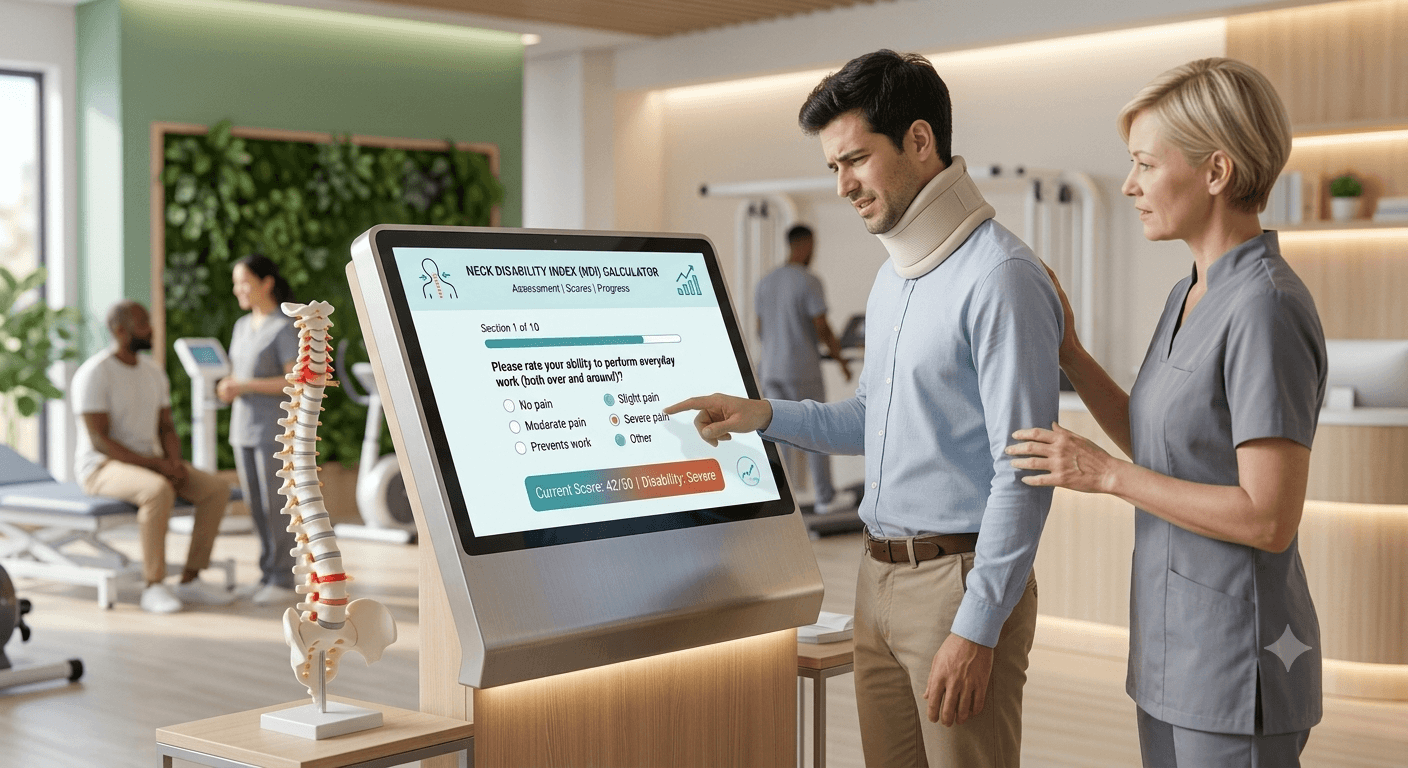
This assessment helps you understand how your symptoms affect your daily life. It uses a standardized questionnaire to measure neck-related limitations, including difficulties with personal care, lifting, concentration, work, and recreational activities. Your answers produce a score that can help describe the impact of your symptoms.
Whether your discomfort started recently, developed gradually, or followed an injury, this tool can give you a useful starting point for understanding your current level of function. You can also discuss the results with a healthcare professional to help monitor your progress over time.
Keep in mind that your score describes the difficulties you report. It does not identify the underlying cause of your pain or replace a medical examination.
How Does the Scoring System Work?
The standard questionnaire contains 10 sections, with six response choices in each section. Every answer receives a value from 0 to 5, depending on how much difficulty you experience.
- 0 points: You report no limitation for the activity described.
- 1 point: You experience a relatively small amount of difficulty.
- 2 points: You experience a greater degree of difficulty.
- 3 points: The activity causes substantial difficulty.
- 4 points: You experience very significant limitations.
- 5 points: You report the greatest level of difficulty described by that section.
When you complete all 10 sections, the points are added together. Your total can range from 0 to 50. A higher number indicates that neck-related symptoms are interfering with more aspects of your daily life or making those activities more difficult.
The result can also be expressed as a percentage by dividing your total by 50 and multiplying by 100. This makes it easier to understand the score on a 0% to 100% scale.
Example: Suppose your answers add up to 18 points. Your percentage score would be 36%, calculated as 18 divided by 50, multiplied by 100. This result indicates reported functional limitations, but it does not mean that 36% of your neck is damaged.
What Does Your Result Mean?
Your result provides a general picture of how much your symptoms affect everyday activities. The following ranges are commonly used to interpret the original 50-point scoring system.
| Raw score | Percentage | General interpretation |
|---|---|---|
| 0–4 | 0%–8% | No or minimal disability |
| 5–14 | 10%–28% | Mild disability |
| 15–24 | 30%–48% | Moderate disability |
| 25–34 | 50%–68% | Severe disability |
| 35–50 | 70%–100% | Complete or very substantial disability |
These categories are general guidelines rather than strict medical boundaries. They should not be treated as a diagnosis or a definitive measure of the severity of an underlying condition. Your symptoms, medical history, physical examination, and ability to perform specific activities all matter.
For example, two people may receive the same total but experience very different challenges. One person may struggle mainly with sleeping, while another may have difficulty driving or completing work tasks. Looking at the individual answers can help explain what your total score does not show.
What Activities Does This Questionnaire Evaluate?
The assessment considers 10 areas of everyday functioning. Together, they help show how neck discomfort affects your physical activities, concentration, rest, and participation in daily life.
1. Pain Intensity
This section considers how much pain you experience in your neck. Your discomfort may be mild and occasional, or it may be more persistent and interfere with your routine. Pain intensity is an important part of the overall picture, but it does not explain every limitation you may experience.
2. Personal Care
Everyday activities such as bathing, dressing, grooming, and washing your hair may become more difficult when you have neck stiffness or pain. You might notice discomfort when bending your head, turning to one side, or reaching for something.
Your answer helps describe whether you can manage these tasks independently and comfortably or whether your symptoms make them harder to complete.
3. Lifting
Lifting groceries, laundry baskets, work equipment, or other household items may aggravate your symptoms. You may find that you can lift lighter objects but struggle with heavier loads.
This section considers the limitations you experience during lifting activities. It does not establish a medically safe lifting limit for your individual condition.
4. Reading
Reading may require you to hold your head in one position for an extended period. Books, laptops, tablets, and phones can all contribute to sustained neck positioning.
If your symptoms increase while reading, you may need to change positions, take breaks, or shorten the time you spend on the activity. Your response reflects how much this affects you.
5. Headaches
Neck discomfort can occur alongside headaches. Some people notice that their headaches become more troublesome when their neck is stiff or painful.
This section considers the effect of headaches on your functioning. However, a questionnaire cannot determine whether your headaches originate from your neck or another cause.
6. Concentration
Persistent discomfort may make it harder to focus on conversations, reading, studying, or work. You may find yourself distracted by pain or needing more breaks than usual.
Your answer helps capture this practical impact. It does not independently measure memory, intelligence, or cognitive ability.
7. Work
Neck symptoms can interfere with many kinds of work, whether you sit at a desk, operate machinery, perform physical labor, drive professionally, or provide hands-on services.
You might struggle to maintain one posture, turn your head, use a computer, or complete repetitive tasks. This section considers how much your symptoms limit your ability to perform work-related activities.
8. Driving
Driving may become uncomfortable if you have trouble turning your head to check traffic, look over your shoulder, or maintain a comfortable position behind the wheel.
If neck pain prevents you from checking your surroundings safely, do not drive until you can do so safely and have obtained appropriate medical advice when needed.
9. Sleeping
Pain or stiffness may make it difficult to find a comfortable sleeping position, fall asleep, or remain asleep throughout the night. Poor sleep can also leave you feeling tired and less able to manage daily responsibilities.
Your response helps describe the extent to which your symptoms interfere with rest. Sleep difficulties can have several causes, so persistent problems deserve attention beyond this score.
10. Recreation
Recreational activities help many people stay active, socialize, and enjoy their free time. Neck pain may make it harder to exercise, garden, play sports, pursue hobbies, or participate in family activities.
This section considers whether you can continue your usual interests or whether you have had to reduce or stop some of them because of your symptoms.
How Can You Use Your Score?
Your result can be useful in several ways, especially when you consider it alongside your symptoms and daily experiences.
- Understand your current limitations: Review which activities are most difficult and how your symptoms affect your routine.
- Prepare for an appointment: Share your result and specific concerns with your doctor, physical therapist, or other qualified healthcare professional.
- Monitor changes: Completing the same questionnaire again at an appropriate follow-up can help you and your provider identify changes in reported function.
- Discuss treatment goals: Your responses may help guide conversations about improving sleep, work tolerance, movement, and participation in activities you value.
- Recognize ongoing problems: Persistent or worsening limitations may indicate that you need further evaluation, even if your total falls within a lower category.
Try to answer based on your actual experience rather than how you think you should be functioning. Honest responses provide a more useful picture of the difficulties you are facing.
Can Your Result Show Whether Treatment Is Working?
Repeated measurements can help track changes in neck-related function. If your score decreases over time, it may indicate that you are experiencing fewer limitations. If it increases, your symptoms or their effect on daily life may have worsened.
However, a change in your total does not automatically prove that a particular treatment caused the improvement or deterioration. Your healthcare professional may also consider pain ratings, strength, range of motion, neurological findings, sleep, medication use, and your ability to perform important activities.
Research supports the use of this questionnaire as a measure of neck-related disability, but the amount of change considered meaningful varies across patient groups and clinical circumstances.
For that reason, do not judge your recovery solely by whether you move from one category to another. Even when your overall category remains unchanged, improvement in a specific activity may be important to your quality of life.
What Can Cause Neck Pain and Functional Limitations?
Neck pain can develop for many reasons. Your symptoms may begin suddenly after an injury or gradually after weeks or months of discomfort.
- Muscle strain: Overuse, awkward movements, or prolonged positioning can contribute to muscle soreness and stiffness.
- Posture and repetitive activities: Extended computer use, phone use, or working in one position may aggravate symptoms in some people.
- Whiplash injuries: A sudden back-and-forth movement of the neck, often associated with a vehicle collision, can cause pain and reduced movement.
- Age-related changes: Changes involving the cervical discs and joints may contribute to discomfort or stiffness.
- Cervical disc problems: A disc bulge or herniation may irritate nearby structures and sometimes contribute to pain, tingling, numbness, or weakness in an arm.
- Nerve irritation: Pressure or irritation affecting a cervical nerve may cause symptoms that extend beyond the neck.
- Other medical conditions: Inflammatory disorders, infections, and less common conditions can also cause neck pain.
These possibilities cannot be distinguished by your score alone. A healthcare professional can review your medical history, examine your neck, and determine whether additional testing is appropriate.
What May Help You Manage Neck Discomfort?
The most appropriate approach depends on what is causing your symptoms, how long you have experienced them, and whether you have any warning signs or other medical concerns.
Keep Moving Within Your Tolerance
For many uncomplicated cases, gentle movement and a gradual return to usual activities can be helpful. Avoid forcing painful movements or attempting aggressive stretches without appropriate guidance.
Adjust Your Workstation
If you spend long periods at a computer, consider positioning your screen near eye level, keeping frequently used items within easy reach, and changing positions regularly. These adjustments may improve comfort, although no single posture works perfectly for everyone.
Take Regular Movement Breaks
Remaining in one position for long periods may aggravate symptoms. Brief, comfortable movement breaks can help you vary your posture during work, studying, or other activities.
Pay Attention to Sleep Comfort
Choose a sleeping position and pillow arrangement that feels comfortable and allows you to rest. If pain repeatedly interrupts your sleep, discuss the problem with a healthcare professional.
Consider Professional Guidance
A doctor or physical therapist can help determine whether exercises, activity modifications, medication, or other treatments may be appropriate. Your plan should reflect your diagnosis, symptoms, medical history, and personal goals.
Do not begin forceful neck manipulation or strenuous exercises simply because your score is high or because you want to lower it quickly.
When Should You Seek Medical Attention?
A high score does not necessarily mean that you have a dangerous condition, and a low score does not rule one out. Pay attention to your symptoms rather than relying on the number alone.
Arrange a medical evaluation if your pain persists, repeatedly returns, interferes with sleep or work, or does not improve as expected. You should also seek assessment if you experience pain that travels into an arm, ongoing numbness, tingling, or weakness.
Seek emergency medical care if neck pain occurs with new or rapidly worsening weakness, difficulty walking, loss of coordination, or a sudden severe headache accompanied by neurological symptoms. Neck pain with fever and severe headache, significant trauma, or other serious symptoms also requires urgent assessment.
Do not use this questionnaire to decide whether emergency symptoms can safely be ignored.
Frequently Asked Questions
1. What is this calculator designed to measure?
It estimates how much neck pain affects your everyday functioning. The underlying questionnaire considers pain, personal care, lifting, reading, headaches, concentration, work, driving, sleeping, and recreation.
2. How many questions are included?
The standard version contains 10 sections. Each section offers six response choices, scored from 0 to 5.
3. What is the highest possible score?
When all 10 sections are completed, the highest raw total is 50. This corresponds to 100% on the percentage scale.
4. Is a higher score better or worse?
A higher score indicates greater reported difficulty with daily activities related to neck symptoms. A lower score indicates fewer reported limitations.
5. Does a low score mean my neck is healthy?
No. A low result means that you reported relatively few limitations on the questionnaire. It cannot rule out an injury, a medical condition, or a problem that has not yet affected your daily activities substantially.
6. Does a high score mean I have a serious spinal condition?
Not necessarily. Your result reflects the impact of your symptoms on daily life, not the severity of structural damage. A clinical evaluation is needed to investigate the cause of your symptoms.
7. Can I use it after a car accident?
It may help describe functional limitations after a whiplash injury or another neck-related problem. However, if you have recently been in a collision, seek appropriate medical assessment rather than relying on a self-assessment alone.
8. How often should I repeat the assessment?
There is no single schedule that is right for everyone. Your healthcare professional may recommend repeating it at the initial evaluation and during follow-up visits to assess changes in your functioning.
9. Can this tool tell me which treatment I need?
No. It can help organize information about your symptoms and limitations, but it cannot determine the cause of your pain or select a treatment. Those decisions require an individualized assessment.
10. What if I cannot answer one of the questions?
Do not guess simply to complete the questionnaire. Follow the instructions provided with your particular version and ask your healthcare professional how to handle an unanswered or inapplicable item. The scoring method may need to be adjusted when a section is missing, and different methods can affect comparisons.
11. Can my score change even if my pain feels similar?
Yes. Your ability to work, sleep, concentrate, or perform other activities may change even when your pain intensity feels about the same. Your responses can reflect these functional differences.
12. Is this assessment a substitute for seeing a doctor?
No. It is an informational and symptom-monitoring aid. It does not provide a diagnosis, replace a physical examination, or determine whether imaging or other tests are necessary.
Important Medical Disclaimer
This online calculator is intended for general educational and informational purposes only. Its results are not a diagnosis, medical advice, or a substitute for evaluation by a qualified healthcare professional. The score should be interpreted in the context of your symptoms, medical history, examination findings, and individual circumstances.
If you have persistent, worsening, or concerning symptoms, consult an appropriate healthcare professional. Seek emergency care for severe or rapidly developing warning signs.
References and Further Reading
- American Academy of Orthopaedic Surgeons: Neck Disability Index questionnaire and scoring
- Shirley Ryan AbilityLab: Rehabilitation Measures Database
- American Physical Therapy Association: Neck Disability Index overview
- Systematic review and meta-analysis of the questionnaire’s measurement properties, published in Disability and Rehabilitation