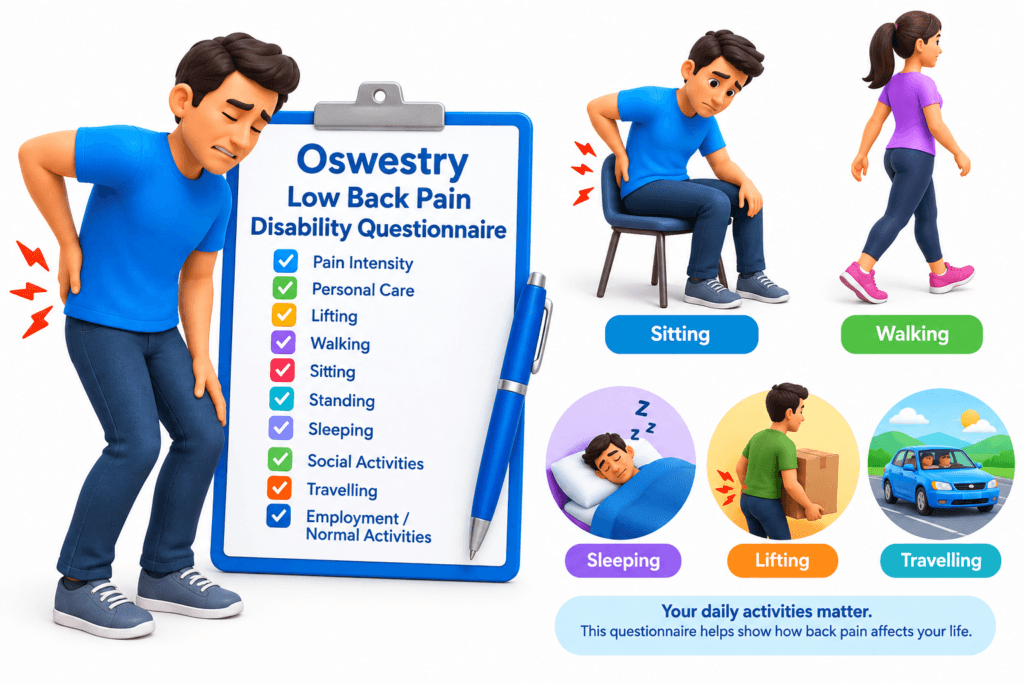
Lower back pain can affect much more than your comfort. It may make it difficult to sit, stand, walk, work, sleep, or take part in everyday activities. To understand how much these problems interfere with daily life, healthcare professionals often use a structured assessment called the Oswestry Low Back Pain Disability Questionnaire.
It is designed to measure the impact of back pain on a person’s ability to manage normal activities. Rather than focusing only on how severe the pain feels, it looks at what someone can and cannot do because of it.
What Is It Used For?
This questionnaire helps clinicians understand how back pain affects day-to-day functioning. It can be useful during an initial assessment and during follow-up visits to see whether a person’s condition has improved, remained unchanged, or become more limiting.
The assessment is commonly used for people experiencing ongoing lower back problems, including those recovering from an injury, surgery, or other treatment.
What Does It Assess?
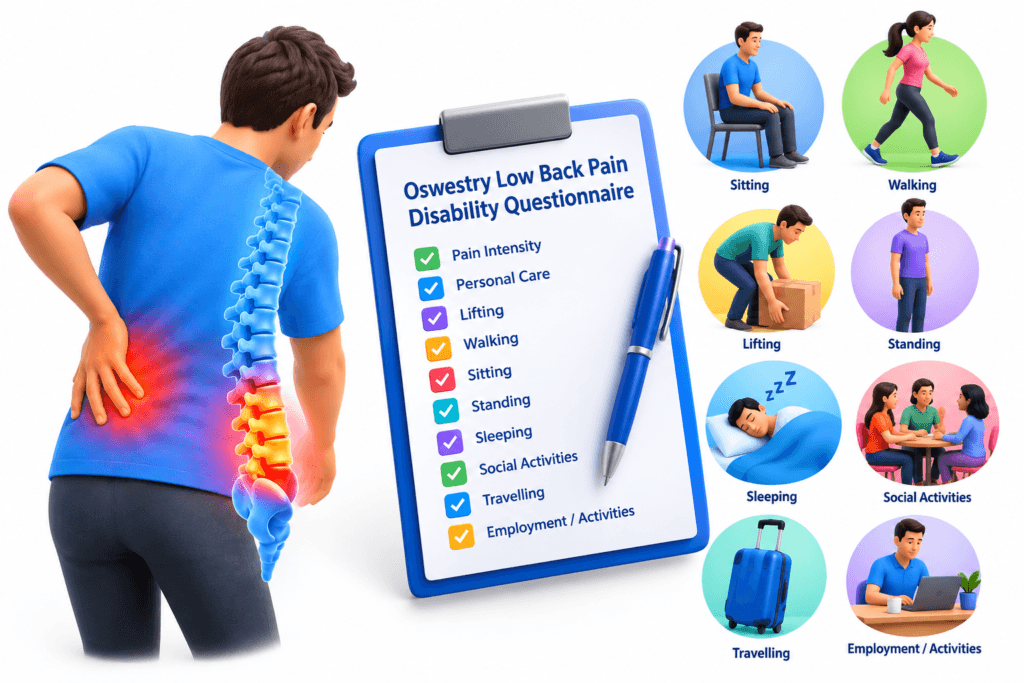
The form covers several areas of everyday life. These generally include:
- Pain intensity
- Personal care
- Lifting
- Walking
- Sitting
- Standing
- Sleeping
- Social activities
- Travelling
- Changes in employment or normal activities
Each section contains several statements describing different levels of difficulty. The person completing it selects the option that most closely describes their current experience.
How Is It Scored?
Each section is assigned a score based on the selected response. The individual scores are then combined and converted into a percentage when appropriate.
A lower percentage generally indicates less disability, while a higher result suggests that back pain is having a greater effect on normal activities. The result should not be considered on its own, however. A healthcare professional may interpret it alongside symptoms, physical findings, medical history, and other assessments.
For example, someone may report considerable pain but still be able to perform most daily activities, while another person with a similar pain level may have much greater difficulty walking, sitting, working, or caring for themselves.
Why Is It Helpful?
One of its main advantages is that it looks beyond pain itself. Two people can experience similar symptoms but have very different levels of functional limitation. By asking about practical activities, the assessment provides a clearer picture of how the condition affects everyday life.
It can also help track changes over time. If a person completes the questionnaire before and after treatment, the results may provide useful information about changes in their level of disability.
How Should You Complete It?
Answer each question based on how your back problem affects you at the time of assessment. Choose the response that best reflects your usual situation rather than selecting an answer based on what you think you should be able to do.
Try not to let an unusually good or bad day influence every response. If you are unsure between two choices, select the one that most closely matches your actual experience.
There are no right or wrong answers. The purpose is to describe your limitations as accurately as possible.
What Does the Result Mean?
The percentage provides an indication of functional disability associated with lower back problems. It is generally interpreted in ranges, with increasing scores representing greater limitations.
However, the number should not be treated as a diagnosis. It does not identify the exact cause of back pain, and it cannot replace a clinical examination. A qualified healthcare professional can explain what an individual’s result means in the context of their symptoms and overall condition.
Limitations to Keep in Mind
Although this is a useful and widely used assessment tool, it has limitations. A person’s answers can be affected by temporary circumstances, changes in activity, mood, other health problems, or differences in how questions are understood.
It is therefore best viewed as one part of a broader evaluation rather than a standalone measure.
Is this questionnaire only for severe back pain?
No. It can be used across different levels of disability. The questions are intended to show how much the condition interferes with everyday activities.
Can I complete it at home?
In many situations, the form can be completed without assistance. If it is being used as part of medical care, your healthcare provider may give you specific instructions.
Does the score diagnose the cause of my back pain?
No. It measures the effect of the condition on daily function. It does not determine whether your symptoms are caused by a particular spinal or muscular problem.
Final Thoughts
Lower back pain can affect people in very different ways. A structured questionnaire provides a practical way to describe those effects and monitor changes over time. By considering everyday activities rather than pain alone, it can help healthcare professionals develop a clearer understanding of a person’s functional limitations.
If your back pain is persistent, worsening, or interfering significantly with normal activities, discuss your symptoms and assessment results with an appropriate healthcare professional.